
Civil Engineering
Roads, water, sewer, stormwater, irrigation, value engineering — the structural bones of every land development project. Bailey designs the infrastructure that takes a parcel from raw ground to buildable lots.
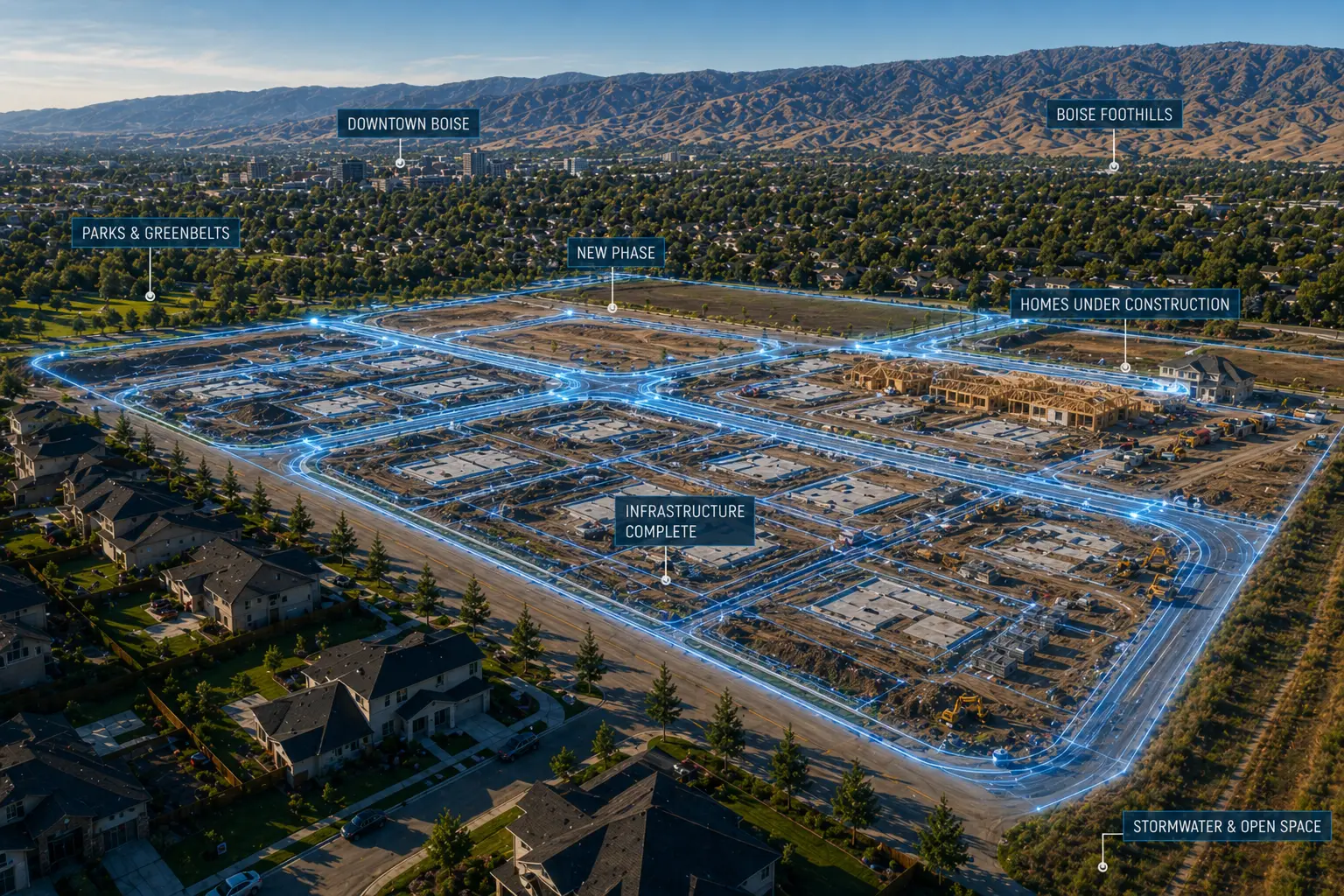
What we deliver.
Civil engineering is the discipline that turns a parcel of land into infrastructure a builder can build on — roads, water lines, sewer mains, storm facilities, irrigation coordination, and the value engineering that keeps the cost where it belongs. Bailey runs all six under one roof, with one team, from feasibility through approved plans, construction observation, and record drawings.
Parcel Analysis
An early parcel-specific read of visible constraints, jurisdiction path, entitlement questions, and the next verification step before deeper due diligence.
Read more → 02Feasibility Studies
The first honest look at a parcel — yield, constraints, infrastructure, approval risk, and a go/no-go recommendation in 2–3 weeks.
Read more → 03Road / Parking Design
Street sections, curb types, parking ratios, ACHD coordination, and the geometry that drives lot yield and project cost.
Read more → 04Water / Sewer Systems
Water distribution, sanitary sewer, fire flow, health department coordination, and the sizing that keeps a project out of the lift station.
Read more → 05Stormwater Management
Detention, retention, BMPs, and the drainage design that turns a cost driver into a site amenity.
Read more → 06Irrigation Systems
Easement coordination with NMID, BPBC, and the canal companies whose infrastructure predates every city in the valley.
Read more → 07Value Engineering
Finding six-figure cost savings without compromising the design — road sections, utility routing, grading, and material choices.
Read more →One team, one continuous workflow.
Bailey keeps one team on a project from feasibility through approved plans, construction observation, and record drawings. The engineer who runs the feasibility study is the engineer who draws the construction documents, coordinates with the agencies, and supports punch-list closeout. That continuity is how we catch the things that fall between handoffs — no re-briefing between phases, no constraint identified in feasibility that fails to make it into the drawings.
The work starts in feasibility, where we pull every relevant constraint on the parcel — zoning, comprehensive plan, utilities, environmental, traffic, topography — and cross-reference it against what the city is actually approving. If the parcel works, we move into civil design: grading the site, routing the roads, sizing the water and sewer, designing the storm system, coordinating with the irrigation district, and engineering the parking and access. Every drawing we produce gets reviewed by the agencies — ACHD, the city, the fire district, the health department — and we manage those comment-response cycles until the plans are stamped and approved.
Construction observation is the phase where approved plans meet the field, and Bailey treats it with the same rigor as design. The contractor performs the work; Bailey provides observation reports, coordinates agency inspections, tracks punch-list items, and turns survey measurements into record drawings for closeout. The team that designed the infrastructure is the team that understands what needs to be verified in the field.
Value engineering runs through the entire process, not as a one-time event but as a continuous discipline. Every road section, every pipe material, every grading strategy gets evaluated against cost, constructability, and long-term maintenance. The savings are largest when value engineering happens during preliminary design, smaller when it happens at bid, and smallest when it happens during construction. We front-load it.
Where it fits in the 9-phase process.
Site Identification & Feasibility
Feasibility studies, parcel research, yield analysis, utility availability.
Entitlements (including Preliminary Plat)
Concept plans, agency coordination, materials and exhibits for entitlement.
CDS — Construction Document Set
Full civil design — grading, utilities, stormwater, streets, irrigation.
Construction
Construction observation reports, agency inspection coordination, and punch-list support while the contractor performs the work.
See the full 9-phase process →
Bailey's construction-phase role is professional engineering support: observation reports, agency inspection coordination, record drawings, and punch-list support. Contractors, builders, and developers perform construction and vertical development.